tinyfarm
- Designed for children over 11 years of age
- 11 Real-time measurements for authentic scientific data collection
- Block programming interface for automating experiments and controlling farm systems
- Living laboratory experience that makes biology, physics, and technology tangible
- Photosynthesis & growth studies with measurable results students can track
- Programmable growing systems teaching automation and computational thinking
- Multi-discriplinary learning suitable from elementary through high school
- Digital integration connects seamlessly with the tinyverse platform
- Collaborative research encouraging teamwork and peer discovery
Transform your classroom into a living laboratory where biology and physics come alive through measurable real-world experiments. The tinyfarm opens up a whole new dimension of learning through experiments that combine physical plant care with digital data collection. With this innovative system, teachers and students can explore biological processes in real time, watching scientific principles unfold naturally and intuitively.
Grow real science with the tinyfarm
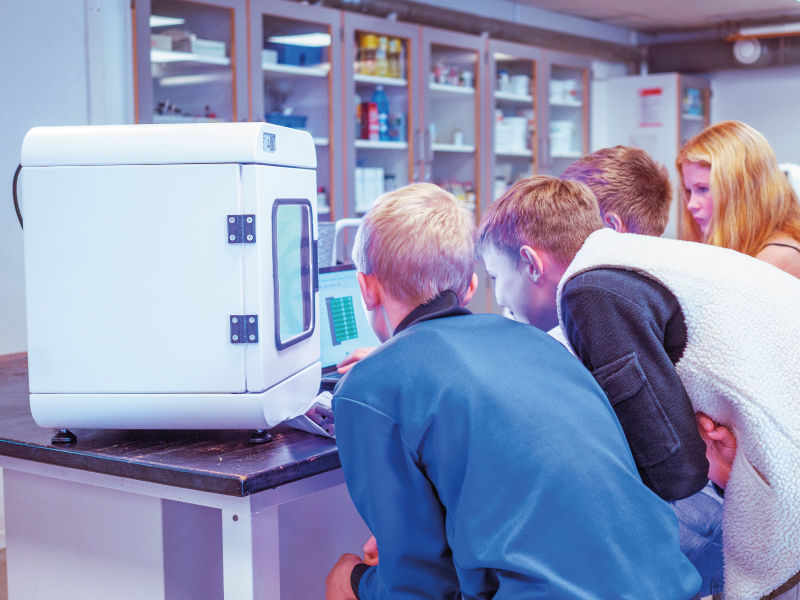
Tinyfarm allows students to grow and analyze plants, providing a unique learning experience that combines science with technology, all in a simple and compact environment that fits into any classroom.
The tinyfarm provides access to 11 measurable parameters and comprehensive STEM experiments that can be used both in the classroom. Whether students are studying photosynthesis rates, testing growth factors, or exploring closed-loop systems, learning becomes hands-on discovery engaging multiple senses – making complex concepts easier to understand and remember.
Beyond science discovery, the tinyfarm is also a powerful tool for collaborative learning. Students can work together more effectively.
Everything you need for instant discovery
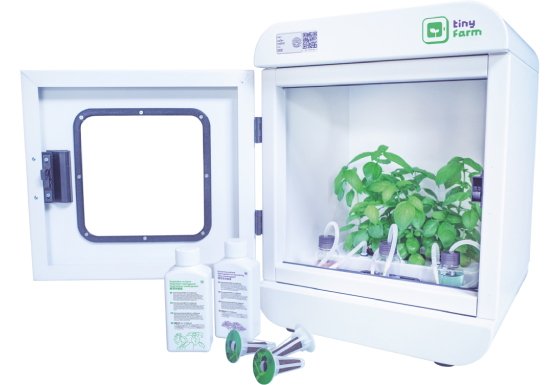
The tinyfarm is a fully equipped system that allows you to quickly start experiments. With nine holders, students can grow multiple plants at once and explore growth, photosynthesis, and differences between different species.
An integrated camera allows for automatic or manual image capture, allowing students to track and analyze growth patterns over time. Built-in sensors measure 11 key parameters, including temperature, CO₂, pH, EC, humidity, nitrogen, phosphorus, potassium, water temperature, water level, and atmospheric pressure, providing authentic data for science experiments.
Adjustable full-spectrum LEDs simulate natural light and allow you to experiment with different wavelengths. Water, nutrient, and air pumps allow you to precisely control airflow and nutrient levels, allowing students to optimize plant nutrition and experiment with different growing methods.
Digital tools for experiment management and teaching
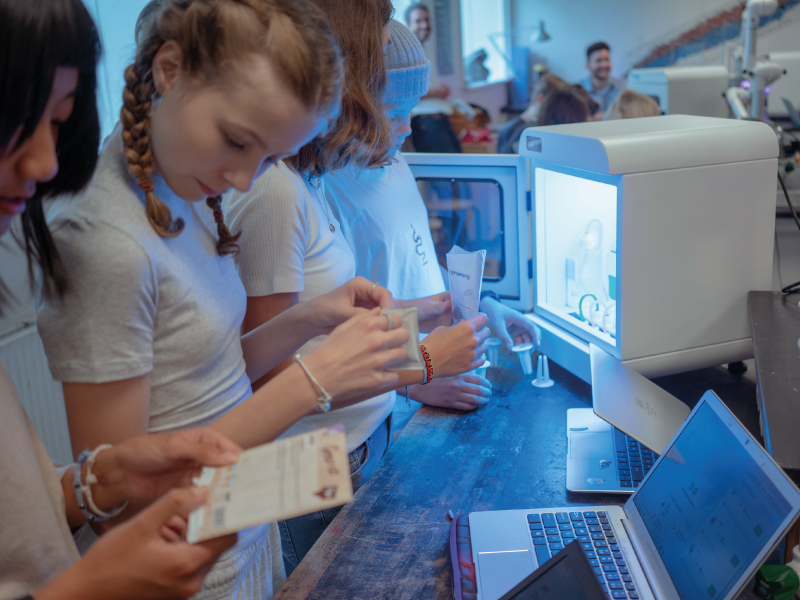
The tinyfarm is compatible with most devices via the tiny app web application – no special software needs to be installed. It works on tablets, PCs, Chromebooks and interactive whiteboards. Whether students are exploring plant biology, environmental impact or programming automation, the tinyfarm turns abstract scientific principles into a concrete and engaging experience.
Teachers will especially appreciate the tinyverse platform, which offers an extensive lesson library, teacher tools, student progress tracking, classroom collaboration and the ability to create their own lessons.

tinyverse